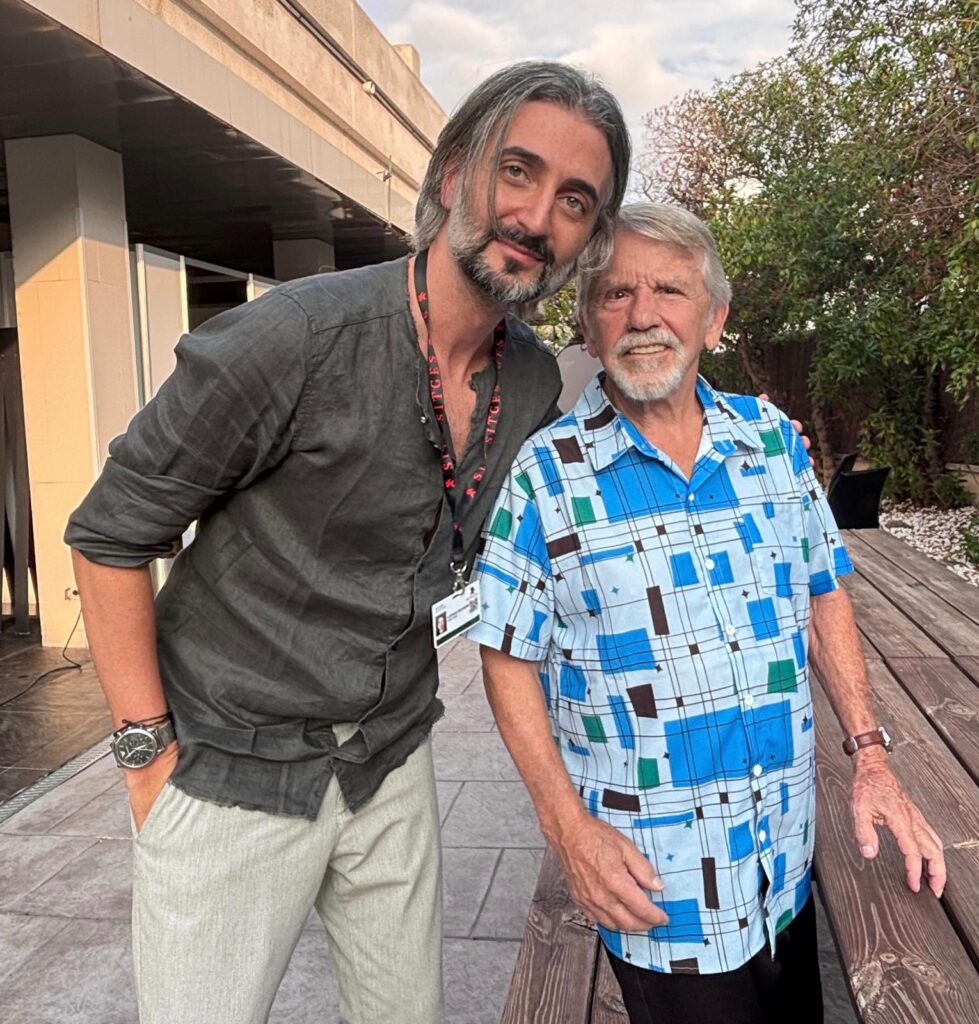
Interview with Sean S. Cunningham (2025)
- byLorenzo Ricciardi
- 10 months ago
- 0 Comment

Many slasher movies today have become somewhat stereotypical. Friday the 13th remains, however, disturbing in its simplicity. If you were to shoot it today, which element would you absolutely keep and which would you eliminate without hesitation?
If I were to shoot Friday the 13th again today I would definitely keep the character of Jason and treat him as a shark, which is what has been done in all the films that have been successful. It’s curious, because that way you give the audience what they want. People who go to see Friday the 13th go there to see Jason do things “Jason-style” and not look for something different or better. As a friend of mine said, sometimes you just want to go eat a Big Mac at McDonald’s. You don’t go to McDonald’s and someone says, “I have this wonderful seafood dish that you have to try.” No, you want a Big Mac, get a Big Mac and stop. I would try to make the story as interesting as possible, but I would start with Jason as he has always been.
So you wouldn’t change anything about the film you made if you did it now?
Well, in the first movie there was no Jason, so it was trying to be a different movie. But in the 10 sequels or so that were made, the audience ended up expecting Jason to do certain things. And when he does them the audience seems to be satisfied. If he doesn’t do them the audience is not happy.
Yet the first one was a success.
Yes, it was very successful. Even without Jason. But it is what it has become over time, not what it was originally. Because at that time nobody had ever seen what we were doing.
Friday the 13th is often regarded as a slasher film, but it also has elements of the Italian giallo, such as the mother figure and the use of subjective . Were you ever influenced, subconsciously or otherwise, by European directors like Argento or Bava?
I saw Argento and Bava, but only after they made Friday the 13th. I had never seen any of those films before. I think it would have helped me a lot to see them. Argento in particular was very intelligent. He created things that, at the time, I thought of as magic tricks. You would watch what was happening and you knew it wasn’t really happening, but it was so good it looked real. Like in magic shows: the magician cuts the girl in half and collects the two halves. You know very well that he didn’t kill her, but it really looks like he did. And that was the beauty of creating something you knew didn’t exist, but it just felt real. Everything changed when we started using computers. Now you could create anything. In those days it was like you could trust the camera. Whatever was on the film, it was what had happened. It was what you saw. Not anymore. So you can’t “trust” the camera in the same way.
In this sense, the soundtrack becomes even more important, just like in Argento’s films.
Exactly. The music tells you what to feel in a given scene. If you feel safe, you can do it. If you feel anxious, you can do it. If there is tension, you can do it. And then you have to go from there. But it’s not just about inventing a song or a melody. It’s about inventing something that works on your subconscious. I don’t think anybody consciously listens to music when it’s being composed. I mean, sure, there has been wonderful music composed for movies. But when you watch the movie itself, you don’t say, “Oh, listen to those trumpets.” It just transports you along with the story. And that’s why I enjoyed working with Harry Manfredini so much, because he is a very good musician and also a very good teacher. He was the one who taught me how music works in a film.
Speaking of Manfredini, did he have carte blanche in the making of the soundtrack? Or did you give him any advice?
No, I did not give advice. I mean, the advice I could give to anybody in such a situation is that “I don’t like it.” But that’s not really advice. Sometimes you may not like a music the way it makes you feel, or it’s too frenetic or something like that. But it’s always a collaborative relationship. And I think a good director has to collaborate with the composer and on what he’s creating in terms of feeling, in terms of telling the story. And in the end, it’s always about telling the story. That’s the key.
Do you still own the rights to the first film? I understand you share the rights to the saga with Victor Miller.
What happened was that the contract we had with Victor Miller expired. It shouldn’t have happened, but it did. He filed a complaint. Or rather, his lawyer, because he had a lawyer, filed a complaint. I said that wasn’t fair. And so we went to court and we lost. And so I said, “Gee, that’s too bad.” And I hope that when the series on Friday the 13th that A24 is preparing takes off, I’d like to be a part of it. But I wouldn’t own it.
When it was released in theaters, Friday the 13th was not well received by critics, but audiences reacted very well.
I really like film criticism, but in retrospect, after seeing the film. I personally prefer not to read anything about a movie before I see it. I would also like to avoid trailers if possible, because I like to be surprised by the stories being told. But what movie critics do is think that the most important thing is what they write, not the movie you see. I never expected to get positive reviews on Friday the 13th anyway. It was not made for that, even though we are here in Sitges still talking about it. Because of the popular success, the film became a landmark. Then came the sequels. I don’t think anyone ever considered it a “serious” movie; it was serious financially, but it wasn’t The Lion King.
Has it ever bothered you that Jason has become an icon, but also a cliché, and in a way has engulfed everything else?
No. I think it was inevitable that Jason would become an icon. And once he became, the people who invested the money and distributed the film knew what they were producing and what to expect, because it was all clear. If Jason changed in every film, or became a woman, I would have said no. It’s a matter of reliability and consistency. I remember hearing someone say that the Friday the 13th films, in general, are films for the “working class,” a film for working people, not for snobbish critics. However, no, I don’t regret anything.
What was the first edit of the film like?
The first edit was not two hours long. I don’t know exactly how long it was, but at that time the difficult thing was to get it to 90 minutes. Usually the shorter version works more because it flows quickly and holds the viewer’s attention more, but stretching it to 90 minutes was complicated. I remember the first screening I did, which had pretty much the editing that everyone saw, had no music or sound effects. It was just to see how the film came out. Wes Craven and Harry Manfredini came and we talked about it together afterwards. Wes, who was a friend, said, “Well, it’s very interesting but it’s awfully slow.” Then, within a month, maybe a little more, there was another screening, this time with music and sound effects. Only then did it work great. The film itself had not changed. When we turned it in to the MPAA to get the rating, I think I took out a total of 14 seconds, so not big cuts. It was just a small part. Honestly, if I had a two-hour edit, I would have shot myself…. [laughs]. I mean, you have to have a story that flows well. Maybe Kevin Bacon’s death was longer, but I don’t think so much. I mean, I think it works fine the way it is. That scene we had worked it out as a magic trick: he’s in bed, she’s gone to a dangerous place, so the viewer thinks he’s probably okay, but we know that on top of him, on the other side of the bunk bed, there’s a dead guy leaking blood. And we see the blood starting to fall. All our attention is focused there. At that point on the other side of the screen comes the arrow. That’s why it’s so amazing.
You were producer of The Last House on the Left, with Wes Craven as director. A film that became a milestone in the horror genre. What are your memories of that experience?
We were both [Wes Craven and I] very young and we were trying to make a film that was unusual and somehow compelling. But it was like sneaking out at night and painting graffiti on the walls secretly, coming home and hoping no one would discover you. We made this film with virtually no money, trying to tell a story. And that story took an unexpected turn halfway through the film: we have these two really lovely girls and at first you think, “oh, they’re definitely going to die.” But they don’t die right away. So as you get more and more into it, you are shocked and really distressed when they are then killed. The second half of the film is characterized by revenge, which happens later. I don’t think revenge is such a good motivation for the characters, but it happened that way. And I think we always understood that that was the goal. We were just guys trying to make a movie.