Interview with Rick Baker (2015–2026)
- byLorenzo Ricciardi
- 4 days ago
- 0 Comment
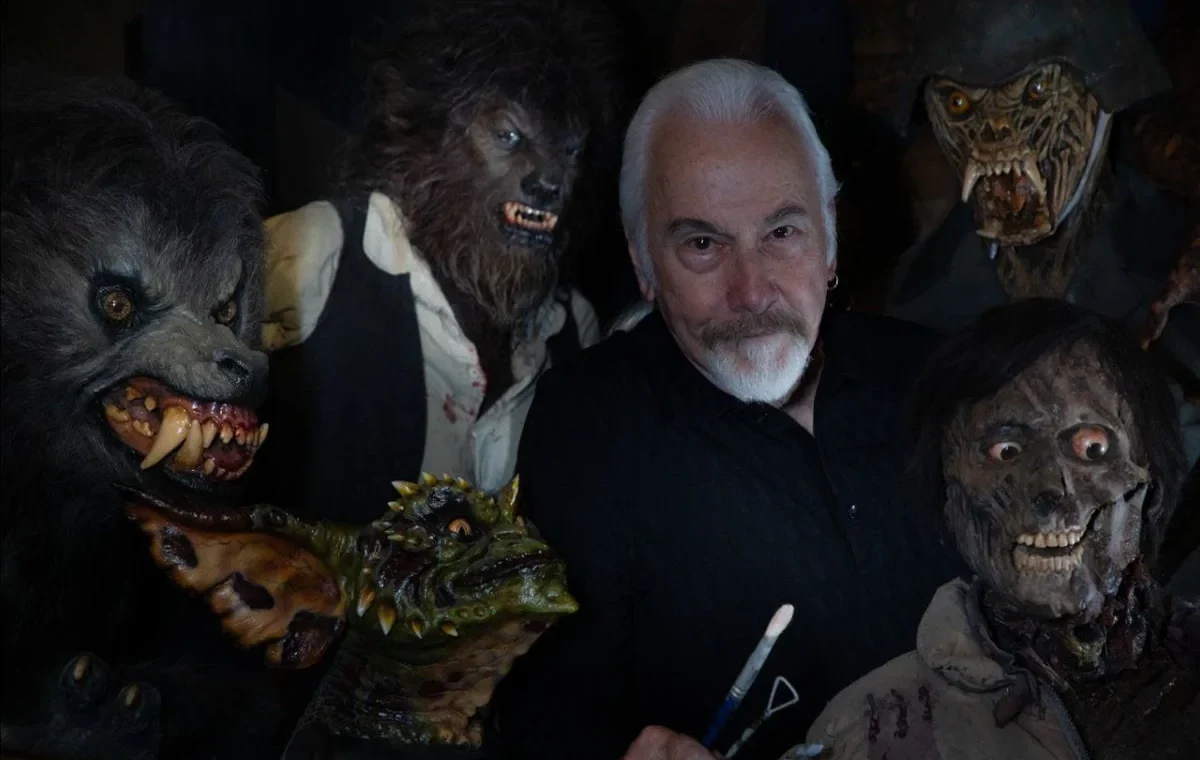
You met Landis on the set of *Schlock*. Even back then, he had already written most of the story for *An American Werewolf in London*, right?
Yes, we met while filming *Schlock*. John had already written the script and had a very clear idea of what he wanted to do. The story was essentially the same as the one we ended up filming several years later, except for a few scenes, like the one in the porn theater.
Did you already have a clear picture in your mind of the transformation scene exactly as it was ultimately filmed?
At the time, we didn’t yet know how we’d manage to pull it off, but John didn’t want the classic transformation using a cross-fade, as had been done in the past. The actor wasn’t supposed to just sit in a corner, motionless. He always thought the moment of the transformation would be very painful. He also wanted the protagonist to be naked to show that his entire body was about to change. He wanted something spectacular. And for that reason, he wanted it all to be shown in broad daylight. It was challenging.
Is that why Landis decided to shoot that scene after the movie was finished?
That’s right. We planned everything and created all the various storyboards for the transformation. And John, since the scene would take a very long time to shoot, decided to film it after all the other scenes were finished. Only a few of us stayed on, and we shot for six days straight—almost ten hours each day—with only David Naughton from the cast.
You almost worked on the set of Joe Dante’s *The Howling *. How did that go?
Joe Dante called me; he wanted me to do the special effects for *An American Werewolf in London*. I’d always wanted to make a movie about werewolves, and at that time, Landis’s film wasn’t ready to start production yet. There wasn’t a script for Dante’s film yet, so the producer lent me the book on which the film was based. They told me I’d have a lot of creative freedom in designing the werewolf and filming the special makeup effects I’d be creating. The offer was truly tempting. But I’d already given my word to Landis, so I suggested Rob Bottin to them. I knew him well; he’d started working with me when he was fourteen. I served as a supervisor, both before and during filming. Whenever he needed it, I advised him on the best course of action. But I ended up suggesting most of the ideas I’d come up with for *An American Werewolf in London* to him. He then, of course, added his own. And he did a great job.
But didn’t Joe Dante know anything about your agreement with John Landis?
No. I don’t think I told him anything. So, as often happens in Hollywood, we started working on it. We began developing some designs and preparing the effects. Then John Landis called me and said, “Good news! I’ve secured funding for *An American Werewolf in London*!” And I said, “Oh, shit!” I had just started working on another werewolf movie! And he said, “You jerk!” “You didn’t tell me you were going to do that transformation!”
Actually, I had told him that. Sort of. But he kept saying, “You ugly bastard! I’m going to kill you!” And I said, “I’ll take care of everything, I’ll take care of everything!”
Rob was my first student. When he came to me, he had never done a special effect in his life. On weekends, he would come stay at my apartment, and I taught him the trade. He got to a point where I knew he would be perfectly capable of handling that job. Incidentally, I had already recommended him to Joe for *Piranha*, to create the creatures for the film. So I entrusted the project to Rob. Unfortunately, *The Howling* came out first. But in the end, John forgave me!
Do you think Rob has used any of your ideas?
I’d mentioned it to him. I mean, we’d even hinted at a few things. I told him, “I’d really prefer it if you didn’t do that transformation with your body lying on the floor. I’d like you to avoid doing it that way.” But Rob has an extraordinary imagination, and I knew he’d come up with some fantastic solutions on his own. And sure enough, he did. But yes, none of this would ever have happened if I hadn’t entrusted him with that job, if I hadn’t trusted him. And you know, it’s interesting: recently another makeup artist came up to me and said, “Do you realize that many of the most important films in the history of special effects makeup would never have existed without you? If I hadn’t taught Rob Bottin the trade, for example, we’d never have had *The Thing*.” And I replied, “Exactly! That damn bastard pulled off everything we’d always talked about doing—times ten—in that movie!” But it made me proud. To think that, yes, that movie might not have existed. Nor would many others. I’ve helped so many people.
You also have to have the skills to do it…
Yes, but the thing is, Dick Smith had always been very generous with me in sharing his knowledge, and I wanted to be like Dick Smith. So whoever came to me found someone willing to teach them. Rob Bottin was my first student, Greg Cannom the second. Then Steve Johnson, Tony Gardner… All these guys came to me.
Rob Bottin, however, has practically disappeared. We haven’t seen him in years…
It’s Bigfoot! I haven’t spoken to him in about forty-five years. He’s always been very elusive. I won’t say any more.